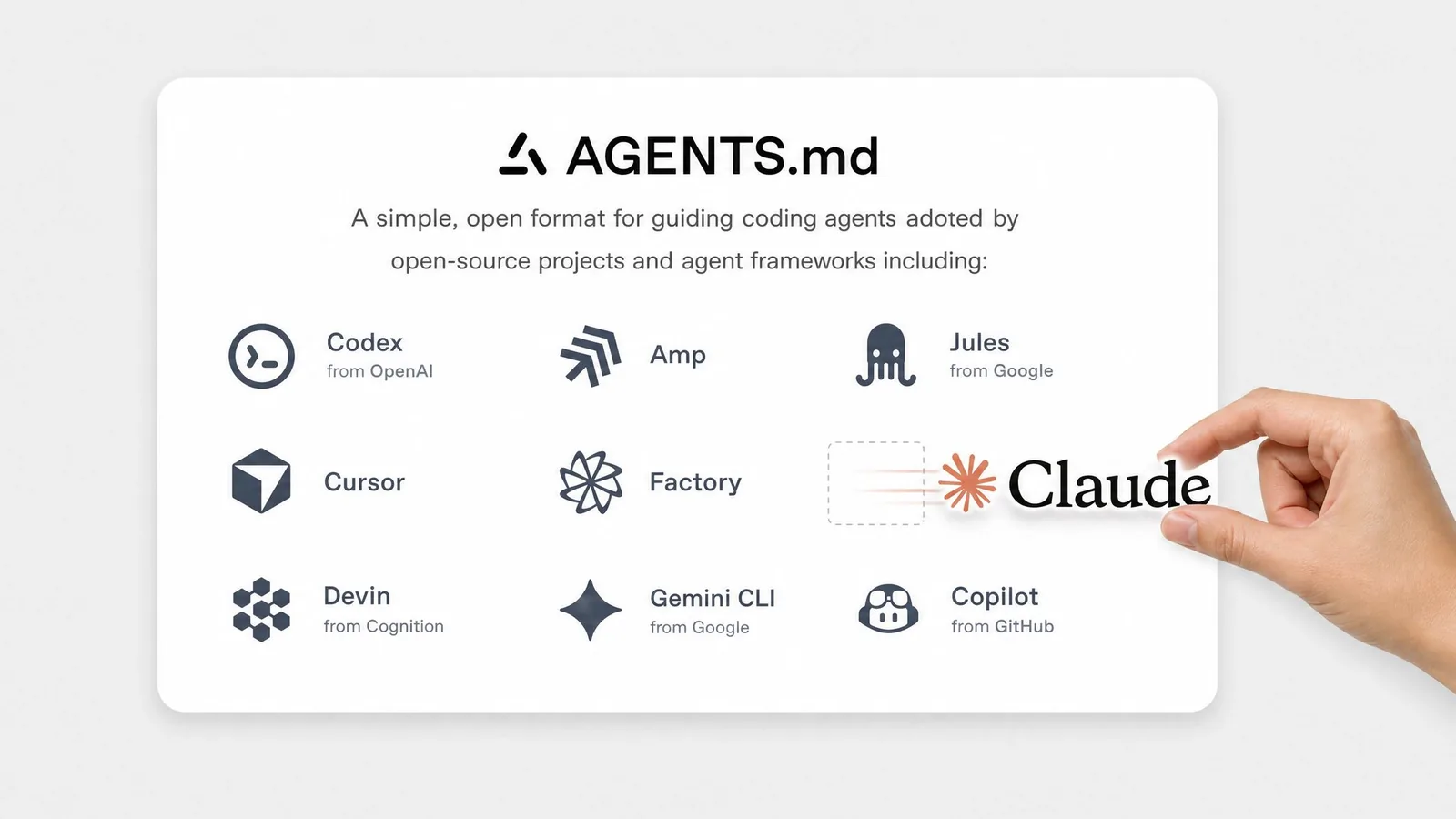
Shopify's Claude Code Warning: AGENTS.md Support
Shopify CEO Tobi Lütke may ban Claude Code over AGENTS.md support. See how fragmented agent system prompts and skills affect Codex teams.
Read articleTopic Pillar & Hub
The Complete Field Guide to Claude Code, AGENTS.md, and Agent Execution Loops
Claude Code represents Anthropic's terminal-native agent paradigm. Unlike traditional chat assistants, Claude Code executes filesystem operations, runs terminal commands, and resolves complex coding problems in loops. Building reliable workflows with Claude Code requires mastering context management, AGENTS.md instruction formatting, and token cost governance.
Structuring project memory and rules without prompt bloat. Preventing instruction drift across long subagent execution loops.
Strategies for pruning history, managing 200K+ token sessions, and leveraging caching proxies (like pxpipe) to slash API overhead.
Equipping Claude Code with specialized Model Context Protocol tools, custom slash commands, and multi-agent coordination.
Set up AGENTS.md / CLAUDE.md guidelines that prevent hallucinations and align coding style.
Know when to commit, restart sessions, and prune context before token cost compounds.
Extend Claude Code beyond basic bash commands with domain-specific tools and external APIs.
AGENTS.md has become the de facto open standard across multiple coding agents (Codex, Cursor, OpenCode). Maintaining cross-compatibility ensures your codebase rules work universally without proprietary lock-in.
Use targeted file referencing, modular task splitting, and clear stop conditions rather than asking the agent to inspect the entire workspace unconditionally.
Field Reports & Case Studies
Shopify CEO Tobi Lütke may ban Claude Code over AGENTS.md support. See how fragmented agent system prompts and skills affect Codex teams.
Read articlePractical Claude Code habits that reduce context noise, protect prompt cache reuse, and keep recurring work in smaller sessions.
Read articleA local Claude Code proxy that renders bulky text as images so Fable 5 bills pixel tokens instead of 92k-character tool dumps.
Read articleFable 5 reopens on July 1 and Sonnet 5 is the new default. Usage, pricing, and why the cheaper sticker can still cost more.
Read articleClaude Fable 5 lasted about 72 hours. The leaked system prompt is still public, and you can load it onto another model.
Read articleOne screenshot and one prompt. Fable 5 rebuilt a production-looking Three.js globe dashboard in a single pass.
Read articleClaude Fable 5 leads on hard coding benchmarks, but the cost is high. Send the hard work to it and keep everyday tasks on cheaper models.
Read article