Google DeepMind opened public access to Gemini 4 Argon on October 13, 2026, following its initial September 30 Fairwind cybersecurity preview. To see how it handles frontend layout and spatial geometry, I ran a harder animated version of Simon Willison's classic "pelican riding a bicycle" SVG test.
Instead of returning a basic CSS keyframe loop, Gemini 4 Argon generated a 2,653-line single-file interactive SVG scene with a real-time 2-bone Inverse Kinematics (IK) leg solver, road gradient physics, three lighting themes, and a live X-ray geometry overlay.
The prompt
Simon Willison's original benchmark asks for a static SVG of a pelican riding a bicycle. I pushed the prompt further by asking for a self-contained HTML file with a smooth looping 2D cycling animation and specific visual details:
Create a self-contained HTML file featuring a pelican riding a bicycle.
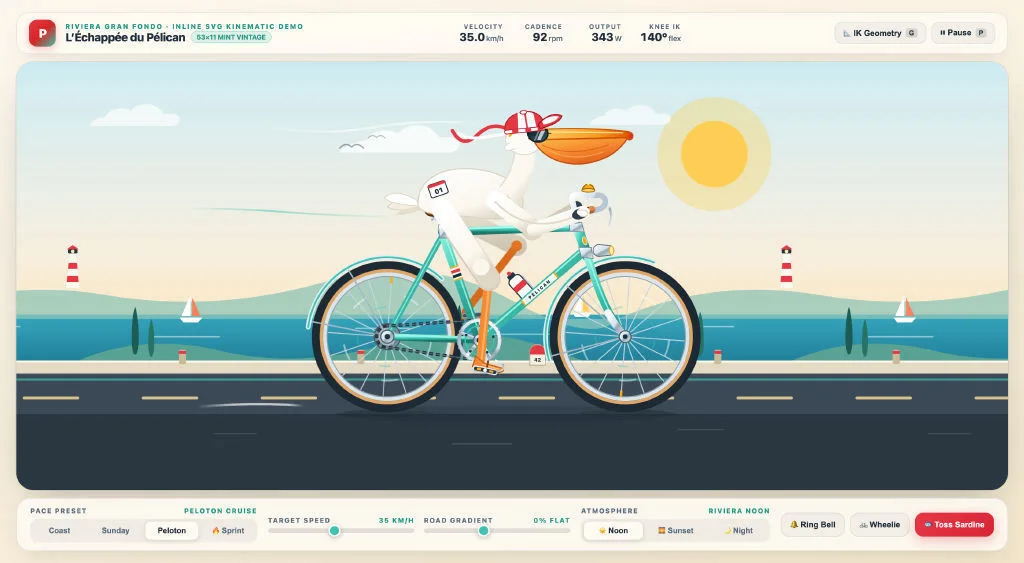
The scene should have a playful, charming illustration style with a clear sky, soft clouds, and a simple road beneath the bike.
Design the pelican with a large orange beak/pouch, expressive eyes, a small cycling cap (red and white), and sunglasses. Its wings should hold the handlebars, and its legs should be positioned on the pedals.
Build a clean, recognizable bicycle with two spoked wheels, a mint-green vintage frame, handlebars, a saddle, and pedals.
Add smooth, looping 2D animations for:
the wheels rotating
the pedals and the pelican's legs moving in a realistic cycling motion
subtle body bounce as it rides
gentle movement in the cap ribbon and feathers
scrolling road markings, clouds, and speed lines to create a sense of forward motion
Center the composition in a responsive card with a warm light background. Use only HTML, CSS, and inline SVG, with no external dependencies.
Why the pelican test still catches weak models
Drawing a pelican on a bicycle in raw SVG forces a model to solve three problems at once without seeing the rendered screen:
- Zero-shot composition: models have plenty of training examples for bicycles and plenty for pelicans, but almost none where a long-beaked waterbird is seated on a road frame with its wings on drop bars and webbed feet clipped to pedals.
- Strict frame geometry: a bicycle frame is a double-triangle truss (main triangle plus rear stays) connecting the bottom bracket, wheel hubs, saddle, and head tube. If those coordinates drift by 20 pixels, the bike looks broken right away.
- Blind coordinate math: the model does not get a visual canvas. It has to calculate every
<path>, Bezier curve, wheel spoke, and joint pivot in<svg viewBox="0 0 1200 650">purely through text tokens.
Earlier on this site, I tested GPT-6 Astra on a 3D Three.js Pelican Pedal Club scene and a 3D logistics globe dashboard. This run strips away Three.js and tests raw 2D vector geometry.
What Gemini 4 Argon built
Gemini 4 Argon framed the page as an interactive cycling telemetry card titled L'Echappee du Pelican (53x11 Mint Vintage).
1. Analytical 2-bone Inverse Kinematics for the legs
Most models animate bicycle legs by slapping a CSS transform: rotate() on a static leg group, which makes the feet detach from the pedals or bends the knees backward.
Gemini 4 Argon wrote an analytical 2-bone IK solver (solveTwoBoneIK) using the law of cosines. On every animation frame, it takes the fixed hip pivot (492, 232) and the rotating crank pin coordinates on a 32-pixel pedal radius, then solves the exact knee joint position for both the near and far legs (thighLen = 84, calfLen = 86). The webbed feet stay locked to the pedals across the full 360-degree stroke, with a realistic heel-drop angle as the crank turns.
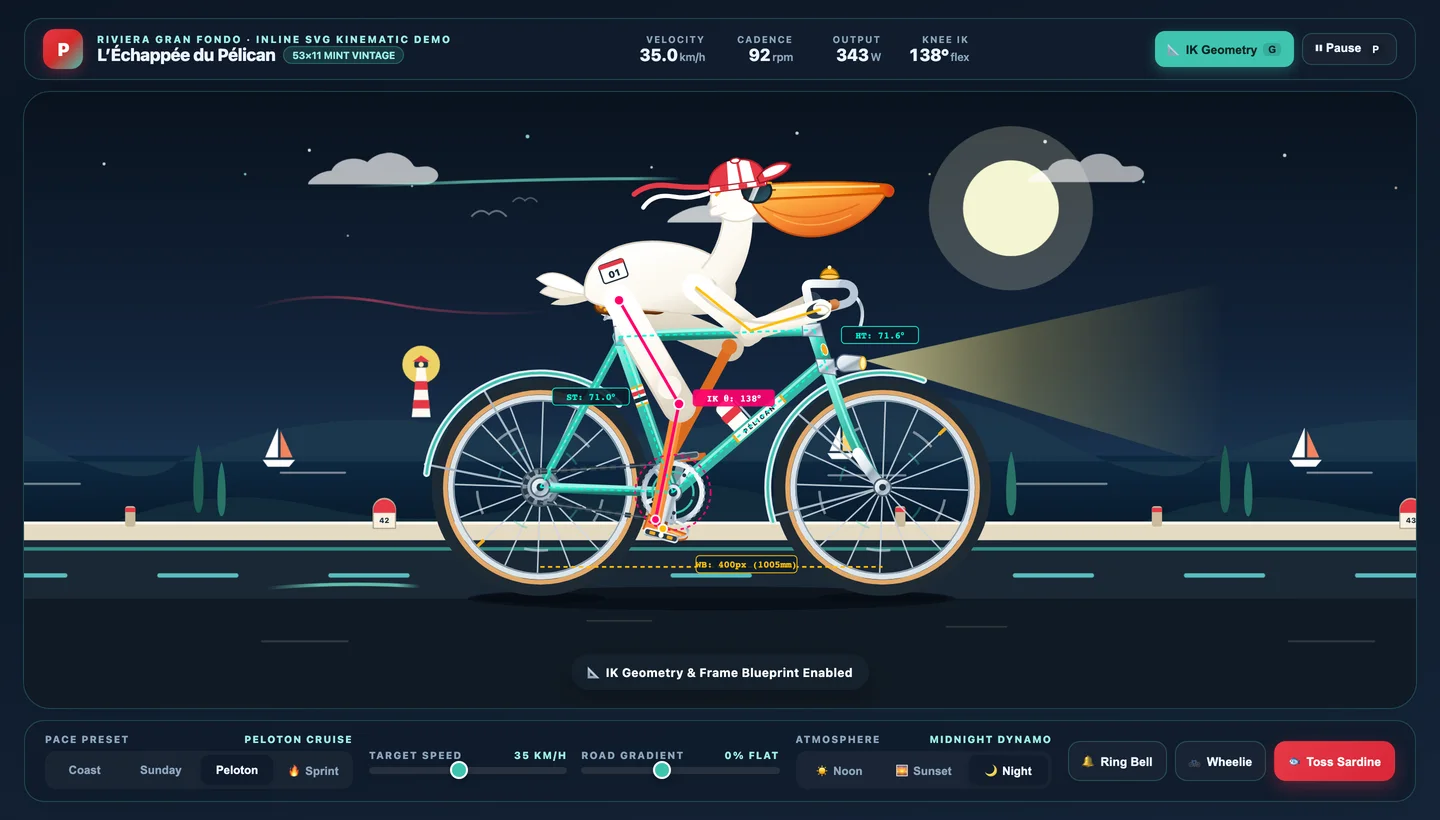
Pressing G (or clicking IK Geometry) turns on an X-ray kinematic overlay. It draws the pedal circle, the hip-to-knee and knee-to-crank vectors, and a live telemetry badge showing knee flexion in degrees.
2. Accurate double-triangle frame and drivetrain
The mint-green frame uses proper lugged steel geometry:
- Rear hub at
(400, 410)and front hub at(690, 410)with 16 tangent spokes per wheel, gumwall tires, and brass valves. - Bottom bracket at
(515, 410), seat cluster at(468, 265), and head tube running from(645, 255)to(655, 295). - A 5-arm alloy chainring with an animated chain (
stroke-dasharray="7 5") whose dash offset advances in sync with the crank angle. - Red-white-blue French champion stripes on the seat tube, a downtube water bottle cage, and a chrome vintage headlamp.
3. Speed presets, road gradient, and lighting modes
Beyond the base animation, the model added a bottom control dock with keyboard shortcuts:
- Four pace presets (
1to4): Coast (0 km/h, where the pelican stops pedaling and levels the cranks while the wheels keep rolling), Sunday (22 km/h), Peloton (35 km/h), and Sprint (54 km/h, where the pelican leans forward +5.5 degrees into an aero tuck). - Road gradient slider (
-8%to+12%): tilts the entire road and bike assembly and adjusts the computed wattage output in the top bar. - Three atmospheres: Riviera Noon, Golden Sunset, and Midnight Dynamo (which turns on a glowing headlamp cone, rear safety tail light, lighthouse beams, and floating fireflies).
- Brass bell and sardine toss: clicking Ring Bell (
B) synthesizes a dual-inharmonic brass ping (1568 Hzand2349 Hz) via the browser's Web Audio API with zero external sound files. Clicking Toss Sardine (F) launches a silver sardine along a parabolic arc; as it nears the beak, the pelican opens its orange gular pouch wide, catches the fish, and triggers a throat-swallow bulge down the neck.
The caveat: it used inline JavaScript
There is one clear constraint miss worth calling out. My prompt ended with:
Use only HTML, CSS, and inline SVG, with no external dependencies.
Gemini 4 Argon kept zero external dependencies and rendered 100% of the graphics inside inline SVG, but it wrote roughly 1,100 lines of inline vanilla JavaScript to drive the requestAnimationFrame loop, the 2-bone IK solver, the control dock, and the Web Audio bell.
If you grade the prompt strictly as a CSS-only challenge, adding <script> breaks the rule. In practice, pure CSS cannot compute law-of-cosines inverse kinematics per frame or synthesize audio waveforms. The model traded strict CSS purity for a working kinematic rig that keeps the feet attached to the pedals.
Takeaway
The pelican-on-a-bicycle prompt remains a fast sanity check for a new model's spatial reasoning. Gemini 4 Argon nailed the bicycle truss geometry, layered near-and-far leg depth, and pedal kinematics on the first shot.