Tencent released and open-sourced Hy4 preview on August 28, 2026. The model has 770B total parameters, activates 49B parameters per token, and supports a 1M-token context window.
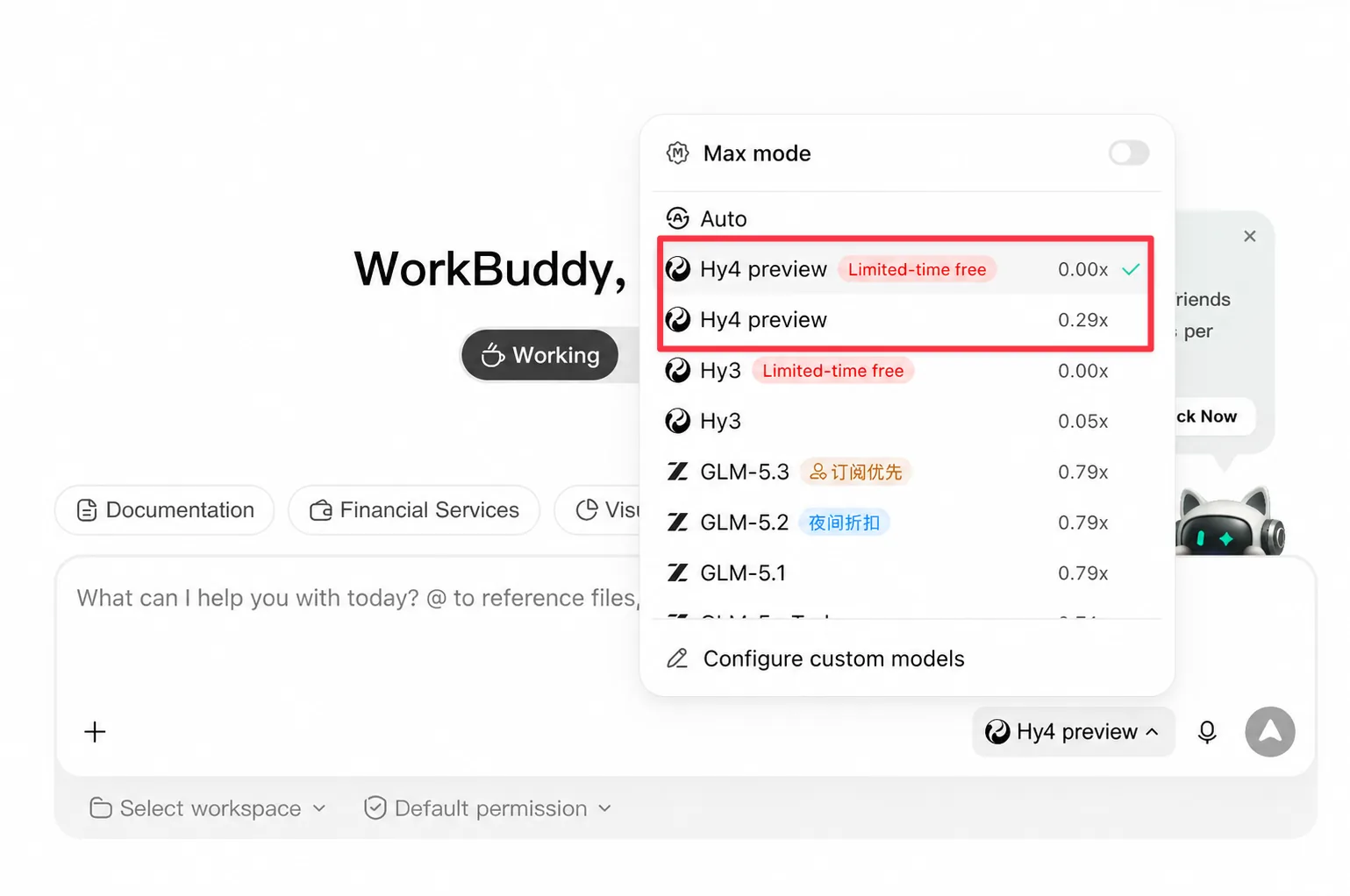
The useful part for builders is immediate access. WorkBuddy and CodeBuddy offer Hy4 preview free for two weeks after launch. I opened WorkBuddy and confirmed that the model picker shows a Hy4 preview entry marked "Limited-time free" with a 0.00x usage multiplier.
What Hy4 preview is built for
Tencent positions Hy4 preview around productivity work. The official model card focuses on four work areas:
- Software engineering: long-horizon planning, debugging, verification, and front-end interaction quality
- Office and analysis: working across messy files and producing documents, spreadsheets, presentations, and financial models
- Game development: generating playable prototypes and refining them across multiple turns
- Scientific research: reasoning over AI research, molecular dynamics, condensed matter physics, and pure mathematics
The model uses a Mixture-of-Experts architecture. Its backbone has 78 layers, with 256 routed experts and one shared expert in each MoE layer. Each token activates eight routed experts plus the shared expert. Tencent also includes a native MTP layer for speculative decoding.
The implementation uses Gated DeepSeek Sparse Attention with IndexCache for sparse index reuse, plus identity Hyper-Connections in the residual path. Those details matter most to teams deploying the weights. Most users will encounter the model through a hosted product or API.
What the early evaluation says
Tencent ran a blind side-by-side evaluation with 163 internal experts across 203 engineering tasks. Hy4 preview scored 2.99 out of 4, compared with 2.92 for GLM-5.3 and 2.94 for Kimi K3.
In the Kimi K3 comparison, Hy4 preview won 51.2% of tasks, tied 7.9%, and lost 40.9%. These are Tencent's internal results, not an independent public benchmark. The task set, model settings, and judging process can change the outcome, so I would treat the numbers as an early signal rather than a final ranking.
Pricing outside the free window
Tencent Cloud TokenHub lists the following China-region prices per million tokens:
| Meter | CNY | Rough USD* |
|---|---|---|
| Input | 6 | $0.89 |
| Output | 18 | $2.68 |
| Cached input | 0.30 | $0.045 |
*The USD figures use an exchange rate of about CNY 6.72 to USD 1. OpenRouter can show a separate hosted price card, so check the provider you plan to use before estimating a bill.
The cache-hit price is the part that stands out. At CNY 0.30 per million cached input tokens, it works out to about 4.5 US cents. That applies to cached input, not to generated output. Long reasoning traces and large completions still use the output rate.
How to try it
Open WorkBuddy or CodeBuddy and choose Hy4 preview in the model picker. Select the entry marked "Limited-time free" during the two-week window. The offer covers the China and international versions of both products according to Tencent's launch announcement.
For API access, Tencent lists TokenHub and OpenRouter as the available routes. The official model name is hy4-preview. The open-source repository includes vLLM and SGLang deployment recipes, along with BF16 and FP8 model links on Hugging Face, ModelScope, GitCode, and CNB.
A preview model with preview problems
Tencent describes Hy4 preview as an early version. On complex tasks, it can spend longer than necessary reasoning through a problem and repeatedly verify its own work. That can increase latency and output-token usage.
The official chat template defaults to high reasoning. The repository also documents a no_think mode for direct responses. For a quick answer or a lower-cost call, that setting is worth testing before you assume the model needs a long reasoning pass.
The two-week WorkBuddy and CodeBuddy offer is a practical way to test those trade-offs with real files and tasks. Start with a workflow you already know, compare the result with your current model, and keep the run that saves time rather than the one with the largest parameter count.